
A strong, reliable team is like a beehive—a living system where each person carries different knowledge, different strengths, and different angles on the same reality. When that diversity is invited in and given direction, even the most complex challenge becomes workable.
The Collective Leadership Compass is a practical methodology for exactly that: leading in a way that activates what everyone brings and that elevates the quality of your process and collaborative work beyond what any one person could achieve alone. It helps build sustainability not just into outcomes, but into the way you work together, in your process, in how you engage partners, and in what you create.
Developed over 20 years of multi-stakeholder practice across four continents, we at the CLI use the compass regularly in our projects and even internal processes to navigate complexity even in uncertain contexts.

The challenges of our time cannot be solved by any single actor. They require collaboration across organizations, sectors, and communities.
Formal leadership roles remain important but not sufficient. What actually enables progress is more distributed: how people listen, connect perspectives, and let initiative emerge from many places. This is collective leadership. And it is a capacity that can be built.
The heart of the Compass consists of six interconnected dimensions. These are human competencies we all possess but need to cultivate more consciously. When balanced, they create conditions for transformative collaboration. Each dimension strengthens the others through mutual reinforcement.
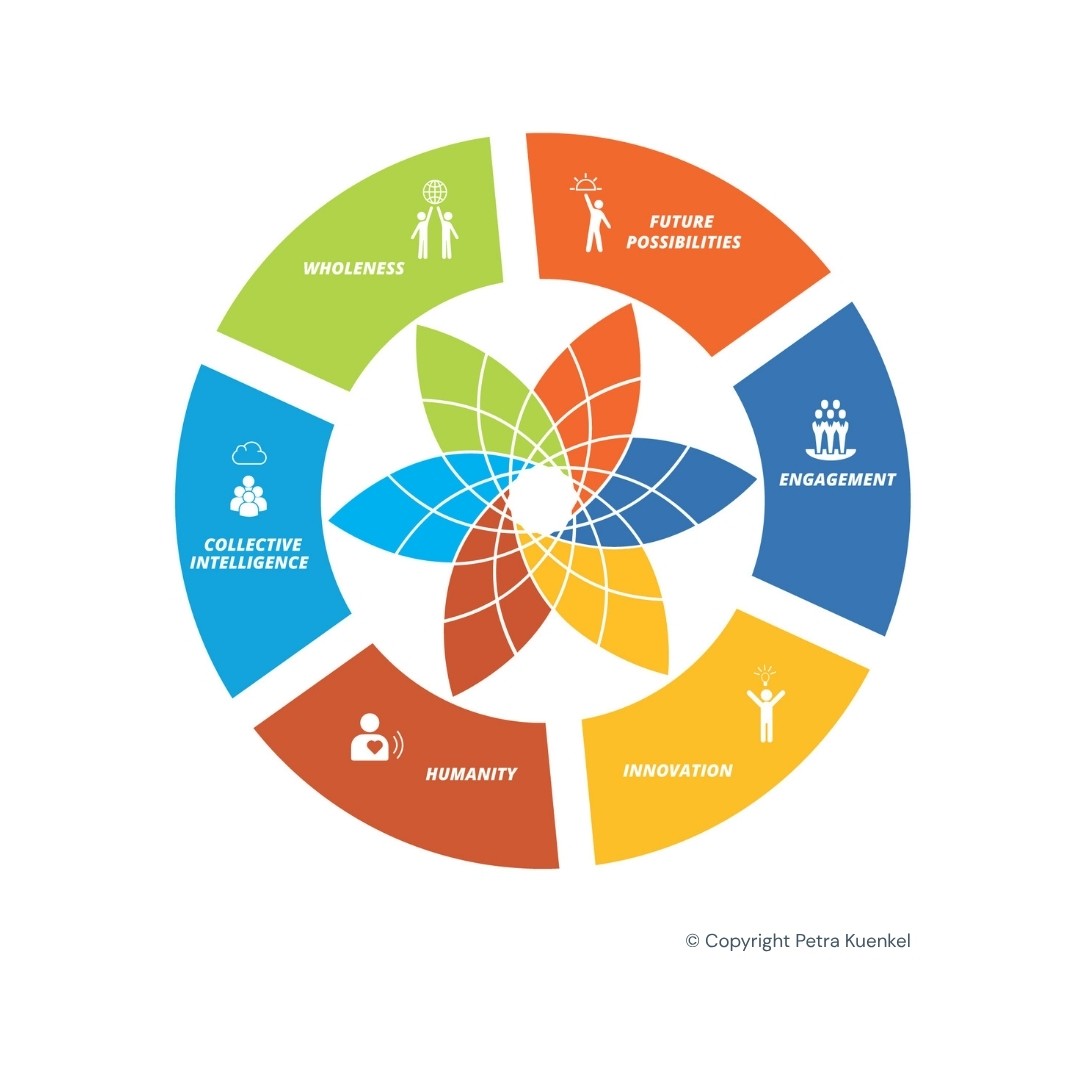
Take responsibility and consciously shape reality toward a sustainable future
Build step-by-step engagement and effective collaboration systems
Create novelty and find intelligent solutions
Reach into each other’s humanness and build constructive relationships
Cultivate dialogue to harvest difference for progress
Stay connected to the global common good and plan within a larger change system
The compass guides an iterative cycle that applies at every level:
Assess what already exists. Which dimensions are strong? Which needs attention? What patterns keep repeating?
Set clear intentions about where to go. Which competencies need strengthening?
Take action, evaluate results, and refine the approach. The cycle repeats, creating continuous learning.
This pattern works whether developing individual capacity, strengthening teams, building multi-stakeholder partnerships, or stewarding large-scale transformation.
Twenty Years of Multi-Stakeholder Practice
The compass was forged in practice. Over two decades of strategic work in complex sustainability initiatives across Africa, Asia, Latin America, and Europe, clear patterns emerged: when collaborators attend to six specific dimensions, things start to work. Outcomes improve, relationships deepen, and impact follows.
Aliveness Theory
Scientists and researchers across disciplines have long observed that life organizes itself through recurring patterns, from ecosystems to cells. The six Compass dimensions mirror these same patterns of systems aliveness. Bringing them into human collaboration doesn’t just improve the process; it tends to unlock energy, creativity, and resilience that rigid structures suppress.
Leadership as the Capacity of a Collective
We tend to think of leadership as something individuals have. The Compass starts from a different premise: that shaping the future is inherently collaborative. As Peter Senge put it, leadership exists when people stop being victims of circumstances and start creating new ones. The Compass helps build exactly that capacity, not in one person, but across a whole system.
Explore some of the most useful tools to explore the Compass guidance
Guide your personal reflection on competencies across all six dimensions of collective leadership.
Reflect on the health of multi-stakeholder collaborations.
Explore and improve the collaboration quality in your team
HOW THE COMPASS GUIDES YOU
The Compass works at three levels, so wherever you are, there’s a meaningful entry point:
Using the Compass in practice strengthens the human qualities that make genuine co-creation possible.
It works across all levels of a system, from a small project team to a large cross-sector initiative, without losing coherence or practicality
It integrates rational decision-making with intuitive sense-making, drawing on the full range of human intelligence rather than reducing collaboration to a checklist
It combines the highest practicality with rigorous academic research into systems thinking
It is built on what people already bring amplifying existing strengths rather than diagnosing what’s missing
It can be applied to different forms of collaboration: partnerships, large-scale networks and community of practice
Dec 3, 2026 · online · English
Free Information Session
Explore how CLI's methodologies support your change initiative
Jun 23 - Jun 25, 2027 · online · English
The Art of Leading Collectively
Navigate change, while strengthing shared leadership and ownership within teams and partnerships.
The basic framework can be grasped quickly. The six dimensions and their relationships are straightforward. However, like any skill, mastery develops through practice. Most people start seeing results within a few months of consistent application.
No. The Compass is about competencies anyone can develop, regardless of title or formal authority. It’s particularly valuable for people working across organizational boundaries without hierarchical power.
While the Compass was developed in the context of sustainability challenges, the patterns of successful collaboration are universal. The methodology applies to any context requiring complex coordination across diverse stakeholders.
Even one person applying the Compass can shift dynamics in positive ways. However, when teams adopt a shared framework, the impact multiplies. Starting with a small core group who can champion the approach is recommended.
The basic tools (assessments, online platform registration, downloadable guides) are free. Courses and workshops have fees, though scholarships are offered for participants from contexts with limited resources.
Yes. CLI has offices in Germany, South Africa, and Egypt. Materials and support are available in German, English, Spanish, French, Arabic, and other languages depending on the program. Please reach out to our Germany office at germany@collectiveleadership.com.
Yes. Many practitioners use the Compass as a diagnostic lens for understanding collaboration dynamics and planning interventions, even when other stakeholders aren’t explicitly familiar with the framework.
