
Any collaboration can stall—in endless discussions, lingering mistrust, or agreements that never translate into action. The Dialogic Change Model is a practical methodology that holds two things together that most frameworks treat separately: the rigor of structured process design and the quality of human dialogue that makes collaboration actually work.
Developed through direct observation of more than 80 multi-stakeholder projects worldwide, it guides diverse actors through four iterative phases—from first exploration to sustained impact.

Even when commitment is strong, collaboration can stall. Traditional project management focuses on structure while underestimating the human dimension: how people talk, build trust, and develop shared ownership. Without attending to both, the best-designed process can produce agreements nobody implements and outcomes nobody owns.
The Dialogic Change Model was built to address exactly this, providing a process guidance that holds structure and dialogue together at every phase.
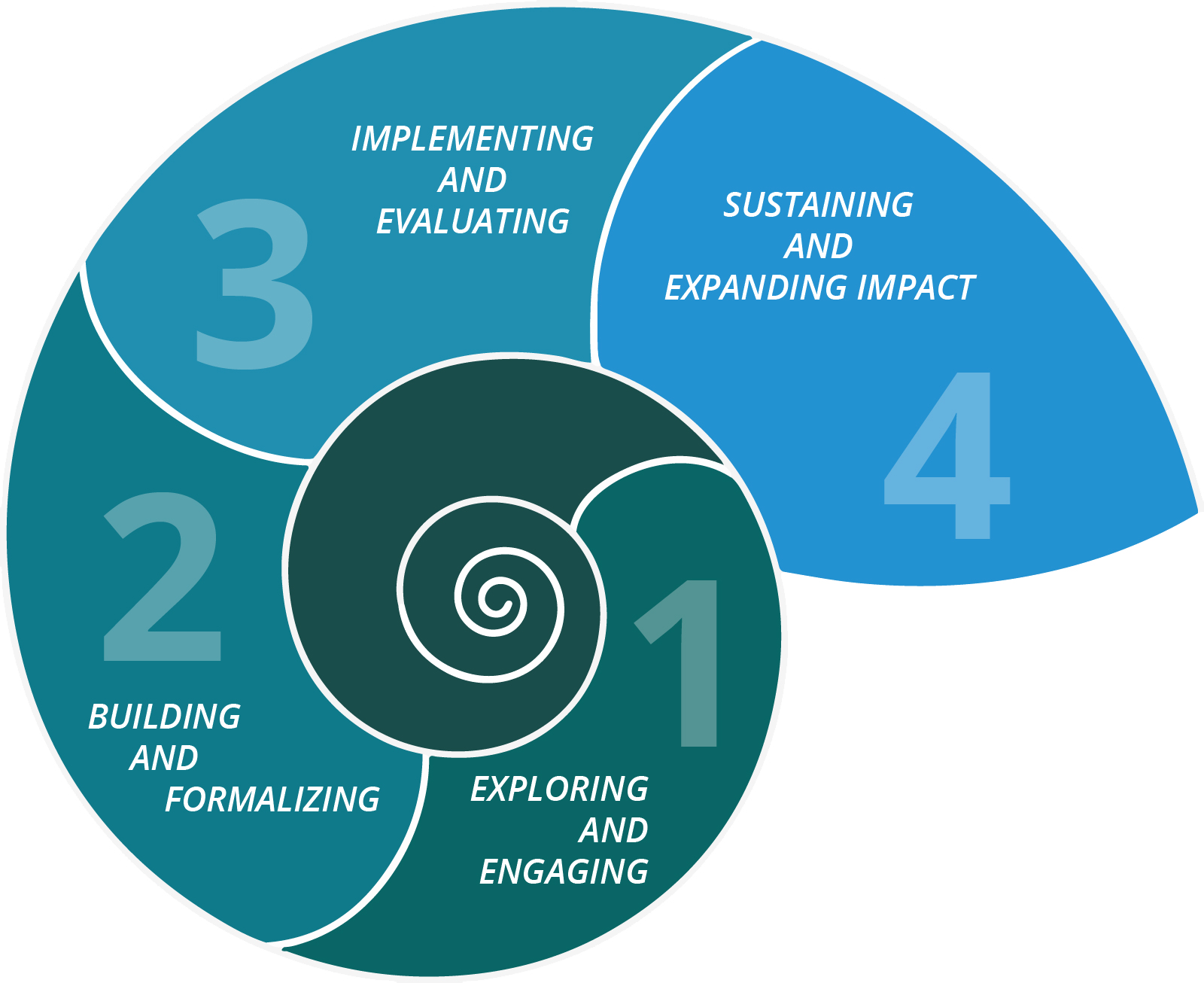
The model guides collaboration through four iterative phases. They are not strictly linear—it is always possible to return to an earlier phase as understanding deepens or circumstances shift.
Phase 1: Exploring and engaging
Raise the energy for change. Understand the context, map the stakeholders, and identify the people who need to be in the room. Build the first trust. A small cross-sector core group—the Container—begins to take shape. Key outcomes: trust among key stakeholders, shared understanding of context, credibility for the initiative
Phase 2: Building and formalizing
Consolidate commitment and give it structure. Roles are defined, agreements are made, and the collaboration officially comes to life — through a signed document, a public event, or a joint project plan. The goal is enough process safety to move forward in an otherwise unpredictable environment. Key outcomes: formal agreements, shared governance structures, clarity on roles, and implementation
Phase 3: Implementing and evaluating
The work begins. This is where plans meet reality—and where monitoring, reflection, and adaptation become essential. Early visible results matter: they show stakeholders that change is possible and keep energy alive. Crises are normal at this stage; the stability built in Phases 1 and 2 is what allows them to be navigated. Key outcomes: achieved milestones, monitoring systems, showcases of success
Phase 4: Sustaining and expanding impact
Once goals are reached, the question becomes: what next? Some collaborations conclude successfully. Others choose to consolidate, replicate, or institutionalize. The major challenge at this stage is keeping the spirit of change alive as structures become more formal and new actors join. Key outcomes: institutionalized dialogue forms, extended stakeholder participation, transferable process experience
The model didn’t emerge from theory—it emerged from a problem. While supporting a global coffee sustainability initiative, Dr. Petra Kuenkel noticed that structure alone wasn’t enough. What determined success was the quality of dialogue and the degree to which stakeholders felt genuine ownership.
Over years of refinement, she led the development process of a model that puts dialogue and collective intelligence at the center of result-oriented change. Across more than 80 projects and 7,000 change agents trained, one finding has proven consistent: dysfunctional patterns—mistrust, lack of ownership, all talk and no action—always compromise results. Attending to the human dimension isn’t a soft add-on. It is the work.
HOW THE MODEL PROVIDES ORIENTATION
The Dialogic Change Model works at three levels—so wherever you are, there’s a meaningful entry point:
Individual: Develop your capacity to facilitate dialogue, navigate complexity, and support others through collaborative change
System: Map where your collaboration currently stands and identify which phase and focus would move things forward
Process: Design and monitor a multi-stakeholder process with clear attention to both structural and relational success factors
The model isn't just a project management tool. Three qualities set it apart:
It balances structure with dialogue: giving collaboration a clear process architecture without reducing it to a checklist or timeline
It is iterative, not linear: stakeholders can return to earlier phases as understanding deepens, making it well-suited to the complexity of real change processes
It is built on practice: developed through direct observation of what makes multi-stakeholder collaboration succeed or fail, across more than 80 projects worldwide
Traditional project management is top-heavy on structure while neglecting dialogue quality between stakeholders. The Dialogic Change Model balances structure with attention to human dimensions of collaboration, recognizing that interaction quality among stakeholders often determines success.
Not necessarily. Many successful collaborations conclude after Phase 3 when goals are achieved. Phase 4 is for initiatives wanting to consolidate outcomes into sustainable structures or institutionalize at a more formal level.
The model acknowledges that crises often emerge during implementation. Returning to tools and elements from Phase 1 to rebuild trust, clarify context, or integrate new stakeholders can help overcome impasses. Stronger foundations built in earlier phases enable better crisis navigation.
Yes. While developed for multi-stakeholder collaboration, its principles apply to any change process requiring coordination among diverse actors, including cross-functional teams or initiatives requiring broad internal buy-in.
The expected results for each phase provide guidance. Movement happens when key outcomes are achieved and stakeholders are ready for the next stage. This requires judgment and attention to collaboration quality, not just task completion.
Effective facilitation requires understanding the model, skill in the Dialogic Practices (voice, listen, respect, suspend), the ability to design appropriate processes for each phase, and awareness of the Collective Leadership Compass dimensions. Our certification program builds these skills through experiential learning.
